
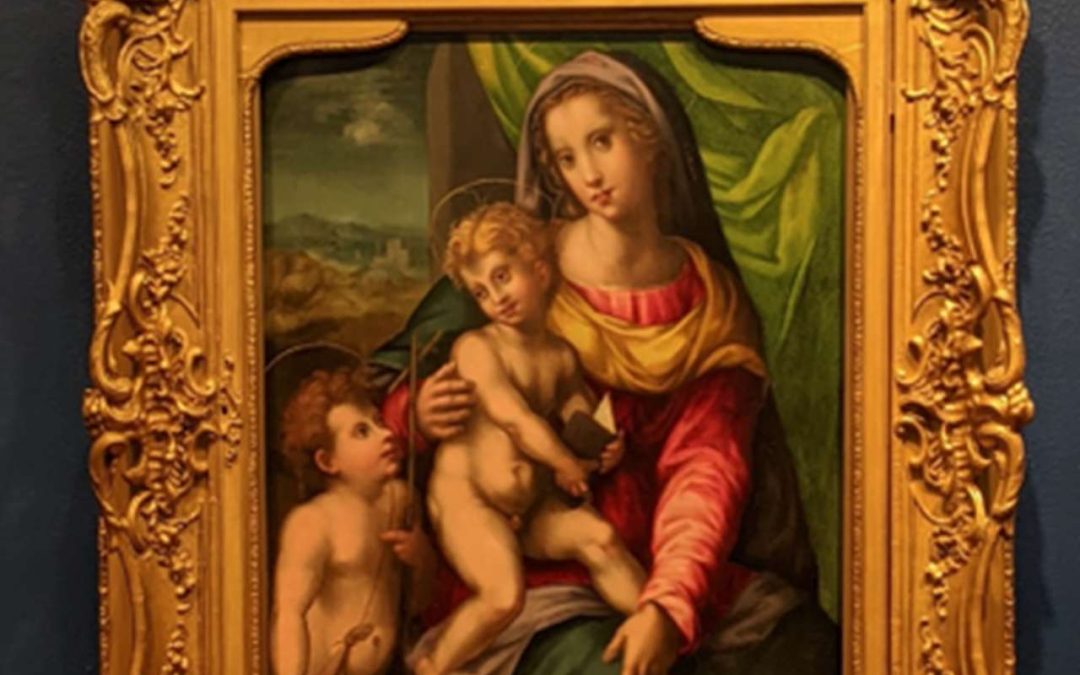
What connection does the Burgh Collection have to this work of art on display in Kirkcaldy Art galleries? Well, the painting of the Madonna and Child once hung in Anstruther Town Hall and Fife Council sought our assistance to find out more.
The story which we helped to unfold begins with Alexander Woodcock who was born in 1810 in St Andrews. He travelled the world as a Royal Navy surgeon before retiring to Anstruther on half pay. He inherited his uncle’s house in Shore Street and practiced medicine from there. (In one reported case he attended to a young farm servant girl who had been trampled and gored by a cow.) Woodcock died in 1885 and we established that he was interred in Anstruther Easter Churchyard where his mother Janet Ballantyne is also buried.
His obituary noted that “Possessing a strong love of the fine arts and an intense passion for the possession of valuable paintings and pictures” he bought a garden on the St Andrews Road (where The Saleroom, opposite the old Waid Academy now is) and built a museum for the storage of his pictures and natural history. Sadly for him, the museum was not a great success as very few local folk were prepared to pay for admission.

This little 3×3 inch photograph is the only known image of the interior of Woodcocks Museum. This photo was owned by Alexander Woodcock himself and is inscribed by him on the reverse, dated 15 November 1880.
Photo courtesy of Andy Sherriff.
Woodcock claimed to have paintings by old masters. Including “masterpieces” by Murillo, Van Dyck, Rembrandt. Others felt however that he was “the victim of unscrupulous print sellers and artists who pawned off on him old and useless prints and pictures.
After his death one such painting, was given to Anstruther Town Council. So was it fake or fortune? Extensive research on the image depicting Mary, with baby Jesus on her knee and the child St John the Baptist alongside has established that it is indeed a 16th century Italian masterpiece and is now being attributed by art experts to the Florentine artist Domenico Puligo (1492-1527). The discovery has attracted worldwide attention.
The beautifully restored painting formed the subject of a major exhibition in Kirkcaldy Art Galleries.